Home / Insights / Work, skills and people
The Entry-Level Job Is Dying. AI Just Accelerated It
 Olivier Gomez (OG)/, 7 min read
A dangerous illusion is spreading through the market right now.
People still think AI is mainly about productivity.
It is not.
AI is restructuring how companies operate.
And one of the biggest casualties is quietly becoming the traditional entry-level job.
That is the real signal hidden inside this conversation.
When you listen carefully, the discussion is not really about AI tools.
It is about something far bigger:
The collapse of the historical pathway into white-collar work.
For decades, the corporate machine worked predictably.
Young graduates entered companies through operational roles:
• junior analysts
• coordinators and assistants
• researchers and reporting staff
• first-line developers
• support teams and administrative coordinators
These jobs were not glamorous.
But they served an essential function. They were training grounds.
The market tolerated inefficiency because developing future expertise required it.
You learned by doing repetitive work. By observing seniors. By making mistakes.
AI changes that equation completely.
Because AI agents are now economically capable of handling a growing share of that entry-level work:
• research synthesis and document creation
• first-draft analysis and reporting
• coding support and workflow routing
• customer communication and scheduling
• data structuring and administrative coordination
Not perfectly. But well enough.
And in business, ‘well enough’ changes everything.
That is the part many people still refuse to accept.
AI does not need to outperform the best humans to reshape labor markets.
It only needs to outperform the economics of hiring humans at scale.
That threshold is already being crossed in multiple industries.
The numbers are no longer theoretical.
According to a 2024 report by the Burning Glass Institute and Strada Institute (Talent Disrupted: College Graduates, Underemployment and the Way Forward), 52% of college graduates are underemployed one year after graduation. Ten years out, 45% are still underemployed. That is not a temporary labor market dip. That is structural scarring.
And it is accelerating.
A June/July 2025 Cengage Group survey found that only 30% of spring 2025 bachelor’s graduates reported finding full-time work in their field. Over 1.4 million newly minted degree holders were either unemployed, underemployed, or working outside their intended careers.
Meanwhile, companies are openly restructuring around AI.
In May 2026, Cloudflare cut over 1,100 employees, roughly 20% of its entire workforce, despite posting record quarterly revenue of $639.8 million. CEO Matthew Prince stated explicitly that agentic AI had ‘fundamentally changed’ how the company operates. Internal AI usage had risen over 600% in three months alone.
This was not a cost-cutting exercise during a downturn. It was a profitable company redefining what human roles it still needs.
Cloudflare is not an outlier. In 2025 alone, AI-cited workforce reductions across US companies exceeded 55,000 jobs, according to Challenger, Gray & Christmas. Amazon cut 14,000 roles. Microsoft cut 15,000. Salesforce reduced its customer support workforce by 4,000 as AI automated up to 50% of tasks.
The pattern is identical everywhere:
A smaller team equipped with strong AI orchestration outperforms a much larger traditional operational team. That changes hiring logic. Completely.
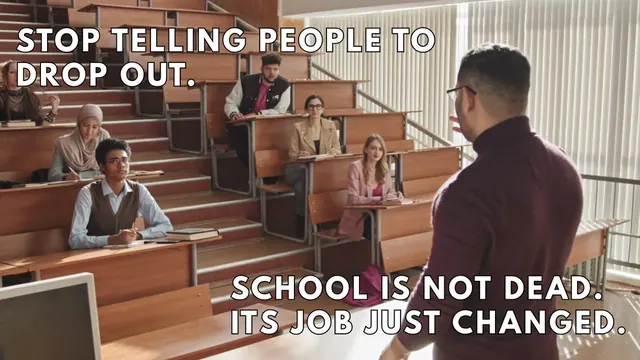
What makes the situation worse is that the education system is still operating with assumptions from a pre-agentic world.
Many schools remain cautious about AI usage. Some actively discourage it. Some still treat it primarily as cheating.
Meanwhile, companies increasingly expect workers to:
• use AI daily
• supervise AI outputs
• structure context correctly
• orchestrate workflows
• validate machine-generated decisions
Young graduates are leaving universities with theoretical knowledge but without operational AI fluency.
The very people who most need AI skills are often the ones being discouraged from developing them early.
That paradox will define career trajectories for the next decade.
This is where the real gap sits. And it is where I spend most of my time.
After 25 years of delivering AI and automation programs across 20+ countries at HP, DXC, and now at IAC.AI, I have seen this pattern repeat itself at every inflection point. In one recent engagement, a cross-industry client absorbed three coordinator roles into a single AI-orchestrated workflow within 90 days, at zero additional headcount cost. The roles did not disappear. The inefficiency did.
Companies think buying AI tools means they are becoming AI companies. They are not.
They are adding intelligence layers onto outdated operating models.
That does not create transformation. It creates chaos.
Traditional enterprise systems were built around human behavior:
• humans request, validate, escalate
• humans approve, own accountability
AI agents disrupt this structure because they do not simply assist. Increasingly, they act.
That forces organizations to answer questions most of them have not yet asked:
• Who owns AI decisions?
• Who is accountable when AI fails?
• What level of autonomy is acceptable?
• How do humans supervise multiple agents simultaneously?
This is not a technology discussion. It is an operating model discussion.
And most enterprises are not ready.
What makes this especially dangerous is speed.
The Industrial Revolution unfolded over decades. Digitization unfolded over decades.
AI adoption is moving exponentially faster. Because software scales globally almost instantly.
The moment a workflow becomes automatable, every company in the world can theoretically implement it simultaneously. That compresses adaptation timelines to months, not years.
And younger workers feel that pressure immediately.
Especially in industries built around informational work: finance, consulting, legal, marketing, recruiting, software development, operations, and administration.
These sectors historically depended on large volumes of junior labor. AI agents are absorbing portions of those workflows. Even partial automation changes hiring economics.
If one AI-enabled employee handles the workload of three, companies stop hiring at historical ratios. That is reality, not hype.
I understand why many leaders are still watching from the sidelines. The noise is real, the hype is exhausting, and most AI pilots they have seen have not delivered. That skepticism is legitimate. But the data above is not hype. It is the market telling you what it has already decided.
The future workforce will split into three groups.
Group one: workers who fully embrace AI orchestration.
These people become massively amplified. One individual manages multiple AI agents, automated workflows, customer interactions, research pipelines, and reporting systems simultaneously. Their productivity scales dramatically.
Group two: workers who remain partially AI-assisted but still operate traditionally.
They survive. But they face increasing pressure.
Group three: workers who resist AI operational integration entirely.
Not because they lack intelligence. Because the market no longer rewards purely manual informational execution at scale.
The mainstream framing is wrong.
People keep saying ‘humans versus AI.’
That is not the future.
The real future is: humans supervising AI-driven execution systems.
The people who become valuable are not necessarily the most technical.
They are the people who can:
• structure ambiguity
• define objectives clearly
• validate outcomes
• coordinate systems across humans and machines
• apply judgment where AI cannot
• integrate business context into machine execution
This is why I believe the most important enterprise role of the next decade is the AI orchestrator.
Not the person building foundational models.
The person operationalizing them safely and effectively inside real businesses.
Because enterprise reality is messy. Every company has fragmented systems, political constraints, compliance issues, legacy infrastructure, human resistance, and conflicting incentives. AI alone does not solve that. Operational orchestration does.
That is exactly why so many AI pilots still fail to scale.
Most companies focus on intelligence. Very few redesign executions.
Adding AI to broken workflows simply accelerates dysfunction. AI scales what already exists. Good systems improve. Bad systems collapse faster.
That sounds bleak. And for organizations that delay, it will be. But the same disruption that punishes inaction creates outsized advantages for the people and companies that move with intent.
But there is a massive opportunity hidden inside this disruption.
Whenever operating systems change, new categories emerge. The people who learn fastest gain disproportionate advantages.
The barrier to execution is dropping dramatically. One highly capable AI-native operator can now achieve what previously required departments, agencies, analysts, assistants, and consultants combined.
The real advantage is not access to AI. Everyone has access.
The real advantage is operational integration. Knowing how to combine humans, workflows, governance, automation, context, and business objectives into a coherent execution system.
That is where the future enterprise battle will be fought. Not model quality alone. Execution quality.
The core question is not whether AI will affect jobs. That debate is over.
The real question is: who learns to operate effectively inside the new system?
The companies winning over the next decade will not simply be ‘AI companies.’
They will be companies that successfully redesign how work itself functions.
And the workers who thrive will not be those with the most prestigious degrees.
They will be the people who adapt fastest to AI-native execution.
The market is shifting from knowledge accumulation to knowledge orchestration.
That transition is already underway. And most people still underestimate how profound it actually is.
If you are working through AI operational integration in your organization and want a straight conversation about what is actually working at scale, connect with me or visit iac.ai.
First published in the OG Approved newsletter on 12/05/2026. Read it on Substack or subscribe to get the next one.