Home / Insights / Ownership and control of AI
Outsourcing Business-Critical AI Is a Mistake
 Olivier Gomez (OG)/, 7 min read
Outsourcing non-core work can make you faster. Outsourcing business-critical AI can make you weaker. That is the part most companies miss.
The debate is not really staff augmentation versus outsourcing. The real question is sharper: what should stay under your control?
Because companies rarely fail because they hired the wrong people. They fail because they chose the wrong delivery model. They need control, but they buy outsourcing. They need speed, but they build everything internally. They need flexibility, but they create a vendor dependency they can never unwind. That is where cost, delay, and lost accountability begin.
Staff augmentation and outsourcing get discussed as if they solve the same problem. They do not.
Staff augmentation is a capacity model. Outsourcing is a delivery model. Hybrid is an operating model.
Confuse the three, and you create friction before a single line of code is written. With AI, that friction is not a delay. It is a moat you accidentally hand to someone else.
Why AI is not like other work you outsource
Most outsourcing logic was built for work that is repeatable, well-scoped, and separable. Help desk. Maintenance. Testing. Documentation. That logic breaks the moment the work is AI.
AI capability is not a deliverable. It compounds. Every model you tune, every agent you ship, every workflow you automate teaches your team something about your own business that no one outside it can fully see. The prompts encode your process. The data encodes your edge. The architecture encodes your decisions.
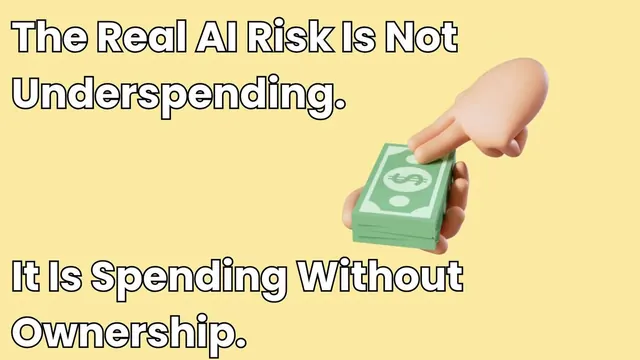
Outsource that, and you are not buying a service. You are renting your own competitive advantage from a third party and paying them to learn it faster than you do.
When the contract ends, the platform may stay. The understanding leaves. You are left with a system you depend on and no longer fully control. That is the quiet trap, and day rates never show it.
The Ownership Test
Before you hand any AI work to a provider, run it through one question.
If losing this capability tomorrow would weaken the business, it never leaves the building.
That is the whole test. If the answer is yes, it is critical. Critical work gets augmented, not outsourced. You can rent the hands. You never rent the capability.
Apply it honestly, and most “let’s just outsource it” decisions reverse themselves on the spot.
The one-way door
Here is the trap nobody prices in. Outsourcing and augmentation are not mirror images. They are asymmetric.
Outsourcing is cheap to enter and expensive to exit. Augmentation is the reverse: a little slower to stand up, but easy to scale down or change direction.
Outsourcing business-critical AI is a one-way door dressed up as a quarterly decision. It looks reversible. It is not. By the time you want out, the provider holds the knowledge, the architecture, and the muscle memory, and buying that back costs far more than you ever saved. Treat every outsourcing decision as a one-way door, and you will outsource far less of what matters.
What staff augmentation really means
Staff augmentation brings external professionals in to support your internal team. They work alongside your in-house staff. They follow your process, use your tools, report into your structure, and close your skill, capacity, or execution gaps.
In AI and automation delivery, that can mean AI engineers, automation specialists, data engineers, QA, designers, or a technical lead.
The main benefit is not extra manpower. It is control. Your company still sets priorities. Your company still owns the roadmap. Your company still decides how the work is done. The accountability for the outcome stays mostly with you.
That is not a flaw. That is the trade-off you want when the work is critical. You get capacity without losing ownership. You get skills without giving away the operating model. You get support without building a dependency that becomes impossible to reverse.
It fits when your internal team is strong but overloaded, when you already have leadership and governance in place, and when you need specialist hands fast without a permanent payroll commitment.
What outsourcing really means
Outsourcing means handing a defined task, project, or function to an external provider. Instead of adding individuals to your team, you ask a vendor to own a piece of work end to end: planning, execution, QA, documentation, reporting, delivery.
Done right, it removes a management burden. The provider runs the process. You review progress and validate results.
That can be very effective, with one condition. The work must be non-core, repeatable, well-scoped, or operational. If the work is business-critical, tied to your competitive advantage, or central to how you operate, outsourcing turns from leverage into exposure.
Not because providers are bad. Because control matters. Knowledge matters. Architecture matters. And once a critical capability sits too far outside the business, you grow dependent on the provider instead of stronger internally.
The real difference: control, ownership, dependency
Staff augmentation gives you external talent while keeping control inside. You assign the tasks, monitor progress, guide priorities, and decide what happens next.
Outsourcing gives a provider more responsibility for delivery. You focus on deliverables, timelines, and service levels.
Neither is automatically better. The friction starts when companies confuse them: they ask for augmentation but expect the provider to own everything, or they outsource business-critical work and later realize they have lost visibility, knowledge, and control.
Cost works differently in each
Both models save money, in different ways.
Augmentation cuts the cost and delay of full-time hiring: recruitment cycles, benefits, onboarding, office space, permanent payroll. The catch is that your team still manages the work, so internal management time stays in the real cost. The upside is that control, knowledge, and ownership stay home.
Outsourcing cuts operational cost by shifting delivery to a provider, useful when building an internal team would be too slow or expensive. The hidden costs are the dangerous ones: weak documentation, rework, slow approvals, security reviews, vendor replacement, and lost internal knowledge.
The mistake is comparing day rates. The better question is which model gets the result with the right level of control, accountability, and risk.
Security, data control, and the questions to ask first
Both models involve external people touching tools, data, systems, code, and customer information. The difference is who manages access.
With augmentation, external professionals work inside your environment. You control permissions. You apply your security standards. That matters for IP, regulated workflows, customer data, finance, healthcare, and government.
With outsourcing, the provider often needs broader access, which raises the governance bar.
So before you outsource anything AI, make the provider answer five questions. Who owns the models, the prompts, and the data when this ends? What is the exit plan, in writing? Who actually holds the knowledge, your team or theirs? How is access controlled, and by whom? Who are the subcontractors you cannot see?
If the answers are vague, that is not a paperwork problem. That is the deal telling you the truth. Security is designed into the model from day one, not bolted on after.
The real decision
Staff augmentation versus outsourcing is not a staffing decision. It is an operating-model decision. Stop asking which is cheaper. Ask instead: what must we control internally, where do we need delivery leverage, what is business-critical, and what knowledge must never leave the company?
Once those answers are clear, the model picks itself.
Use augmentation for control, flexibility, and skill gaps without losing ownership. Use outsourcing for defined, separable outcomes that are safe to externalize. Use hybrid when the work is complex: keep strategy, architecture, and AI governance in house, augment the technical execution, and outsource only the clearly separated edges.
The model should follow the work. Not the other way around.
Why IAC is different
IAC is not a generic staffing vendor. IAC is a technical execution partner.
If you need high-volume recruitment, there are large players built for that. But when the work touches AI agents, automation, workflow transformation, or software delivery, you need more than CVs. You need people who understand the work, the risk, and the operating model, and who help you keep the capability inside your walls.
That is what we do. We add the right people to your existing team, keep control where it belongs, and structure a hybrid model with governance and delivery support when the work demands more than one profile.
Not just CVs. Not just outsourcing. The right resourcing model for the work.
If your team needs specialist capacity to scale AI agents, automation, or software delivery without losing control of what matters most, let’s talk.
Ship AI. Deliver outcomes. Keep control. Book a call: https://calendly.com/oliviergomez
First published in the OG Approved newsletter on 17/06/2026. Read it on Substack or subscribe to get the next one.